
BANC3 Awarded Defense Contract Supporting $151B Golden Dome SHIELD Program
FOR IMMEDIATE RELEASE
Princeton, NJ — January 13, 2026 — BANC3, Inc., a defense product company specializing in space spectrum surveillance, signal intelligence (SIGINT), and software-defined radio (SDR) systems, today announced its selection by the Missile Defense Agency (MDA) under an Indefinite Delivery/Indefinite Quantity (IDIQ) contract vehicle issued pursuant to Solicitation HQ085925RE001. The award supports the Strategic Homeland Integrated Ecosystem for Layered Defense (SHIELD) program.

The SHIELD program represents a long-term, multi-award framework with a total program ceiling of up to $151 billion, focused on advancing next-generation missile defense architectures and space-domain protection capabilities.
Under this award, BANC3 will deliver advanced RF and spectrum technologies to support next-generation missile defense and space-domain missions. The effort leverages BANC3's proven expertise in wideband spectrum surveillance, high probability-of-intercept RF systems, and software-defined architectures to enhance detection, situational awareness, and resilience across contested operational environments.
The SHIELD program emphasizes the integration of sensing, communications, and command-and-control technologies to address evolving threats across air, space, and missile defense domains. BANC3's contribution centers on space-relevant spectrum awareness and RF processing technologies that enable real-time monitoring of complex electromagnetic environments while supporting secure and adaptable operations.
"This award reflects the Department of Defense's confidence in BANC3's ability to deliver mission-relevant spectrum and RF capabilities for some of the nation's most critical defense priorities," said Babu Cherukuri, CEO of BANC3. "SHIELD aligns directly with our core strengths in space spectrum surveillance and software-defined RF systems, and we are proud to support efforts that strengthen missile defense and space-domain protection."
This contract builds on BANC3's established track record of delivering wideband RF spectrum monitoring and SIGINT systems in support of national security missions, including space and launch-related operations. BANC3's modular, software-defined approach enables rapid evolution of capabilities as mission requirements and threat environments continue to change.
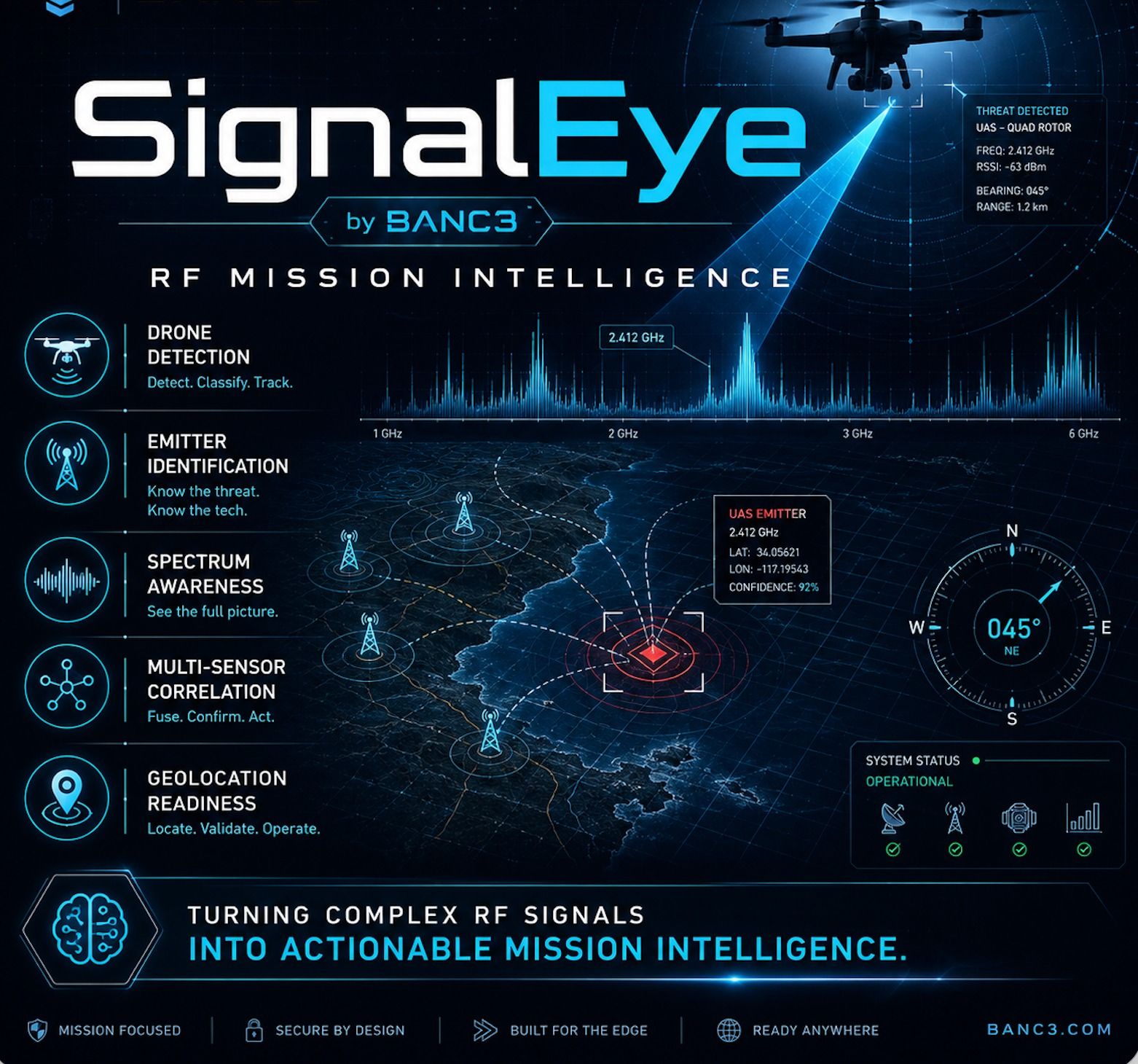
BANC3 SignalEye turns complex RF environments into actionable mission intelligence.
From drone detection and emitter identification to spectrum awareness and multi-sensor correlation — built for mission-critical environments.
See the signal. Understand the threat. Act faster.
#BANC3 #SignalEye #RF #DefenseTech #CounterUAS #SIGINT #ElectronicWarfare
Control of the Electromagnetic Spectrum is Becoming Essential to Mission Success
BANC3 is expanding its role in U.S. national defense by advancing AI-enabled spectrum intelligence, wideband RF surveillance, signal intelligence and software-defined radio systems for increasingly complex and contested environments.
Through platforms including SignalEye™ and SkyGrid™, BANC3 is building capabilities designed to help operators detect, classify and understand advanced signals in real time—supporting greater situational awareness and faster, more informed decision-making across space, airborne, maritime, ground and tactical-edge missions.
Our focus extends beyond monitoring the spectrum. We are developing adaptable, software-defined infrastructure that can evolve alongside emerging threats, new waveforms and changing mission requirements.
Built on more than two decades of experience supporting critical U.S. defense programs, BANC3 remains committed to delivering scalable technologies that strengthen spectrum dominance, operational resilience and national security.
Read the full announcement below. https://www.openpr.com/news/4586371/banc3-expands-role-in-u-s-national-defense-as-spectrum
#BANC3 #SignalEye #SkyGrid #SpectrumDominance #ElectronicWarfare #SIGINT #SoftwareDefinedRadio #SpaceDefense #DefenseTechnology #NationalSecurity #C5ISR
Drone Detection Is the New Air Defense Layer - How BANC3's RF Platforms Solve This
Traditional detection methods are not built for this reality. Radar struggles with low-altitude, low-signature drones. Visual systems require line-of-sight and favorable conditions. As a result, many operators are left with fragmented awareness and delayed response times.
The solution is not another standalone sensor. It is a shift toward RF-based detection and spectrum awareness.
Every drone emits a signal—whether through command links, telemetry, or onboard communications. By monitoring the RF spectrum in real time, it becomes possible to detect, classify, and track drone activity even when the platform itself is not visible. This is where SignalEye™ is redefining the approach.
SignalEye™ leverages wideband RF sensing to continuously monitor the spectrum and identify anomalous activity associated with unmanned systems. Instead of relying on a single detection method, it correlates signal patterns, frequency usage, and temporal behavior to provide early warning of drone presence. More importantly, it enables operators to understand not just that a drone is present, but what type of system it is, how it is operating, and where it may be coming from.
As drone threats evolve, detection must move beyond visibility and into understanding the electromagnetic environment itself. RF is no longer just a supporting layer—it is the primary domain where these systems operate and can be countered.
Looking forward, the next phase is not only detection, but attribution and decision support. Systems must be able to explain what is happening in the spectrum, differentiate between benign and hostile activity, and provide actionable insights in real time. This is the foundation for scalable counter-UAS operations across defense, border security, and critical infrastructure.
SignalEye™ is built for this shift—transforming RF data into operational awareness and enabling a new layer of defense against emerging drone threats.
Watch SignalEye™ in Action
For more information on BANC3’s defense and space solutions, visit banc3.com.
SignalEye™ - Spectrum Surveillance / SIGINT
Real-Time Spectrum Surveillance for Next-Generation Threats with Proven Systems Today
In the modern theater of operations, the electromagnetic spectrum is no longer just a backdrop—it’s a fiercely contested domain. From frequency-agile threats to fast-hopping signals, the "invisible" battlefield is more crowded and dangerous than ever.
As BANC3’s flagship software-defined spectrum surveillance and signal intelligence (SIGINT) family, SignalEye™ is designed to ensure that in a world full of signals, your intelligence remains unmatched.
Watch SignalEye™ in Action
The Challenge: Legacy Systems in a Fast-Hopping World
Modern Electronic Warfare (EW) moves at lightning speed. Adversaries increasingly employ signals that legacy systems simply cannot track. Furthermore, many current SIGINT solutions are hindered by:
Bulk and Weight: Large SWaP (Size, Weight, and Power) footprints that limit deployment on drones or satellites.
Hardware Lock-in: Fixed architectures that can’t adapt once they are deployed.
Fragmented Operations: A lack of unified authority for spectrum awareness across space, air, and ground.
The SignalEye™ Advantage: Software-Defined Dominance
BANC3 addresses these gaps with a direct RF software-defined radio (SDR) architecture. Unlike rigid hardware of the past, SignalEye™ is built for long-term adaptability. It’s not just a tool; it’s a future-ready platform already proven in the field through a Program of Record supporting critical NRO missions (including NROL-87, 85, 91, and 68).
What Sets SignalEye™ Apart?
Unrivaled Bandwidth: With programmable instantaneous bandwidth up to 8 GHz, it captures the most agile RF signals that others miss.
Full-Spectrum Awareness: A single direct RF chip covers a massive range (100 MHz to 50 GHz), providing a 360-degree view of the spectrum.
Mission-Ready Scalability: The architecture supports up to four channels per system and is housed in a compact, 5-pound form factor—perfect for space, maritime, and unmanned platforms.
Post-Deployment Upgrades: Because the system is software-defined, it can be upgraded to meet new threats after it has been deployed, eliminating the need for costly hardware replacements.
"Signal Dominance Defines Mission Superiority."
Bridging the Gap: Tactical to Strategic
SignalEye™ creates a seamless link across all domains. Whether it's a CubeSat in orbit, a tactical ground vehicle in a contested environment, or a strategic command center, the platform provides real-time link optimization and anti-jam resilience.
By adhering to VPX / VITA open architectures, it ensures seamless integration into U.S. and NATO defense frameworks, making it a cornerstone for next-generation RF dominance.
The Bottom Line
In an environment where the spectrum is contested and intelligence is a prerequisite for victory, SignalEye™ provides the clarity needed to act. It transforms raw signals into actionable intelligence, ensuring that no matter how congested the airwaves become, your mission remains on track.
For more information on BANC3’s defense and space solutions, visit banc3.com.
BANC3 SkyGrid™: Software-Defined RF Infrastructure for Modern National Defense
Space is no longer a passive domain. It is contested, congested, and strategically decisive. Modern national defense requires resilient, software-defined RF systems that can operate across multiple frequency bands, adapt in real time, and integrate seamlessly into evolving space architectures. That is the mission behind BANC3's SkyGrid™ Platform.
Built for Multi-Domain Resilience
SkyGrid™ operates across a 1–36 GHz frequency range with dual transmit/receive channels and a wideband architecture. This allows a single payload to support ISR, communications, spectrum dominance, and adaptive mission roles — without requiring multiple dedicated systems.
Instead of static hardware-locked architectures, SkyGrid is designed for reprogrammable, mission-defined RF capability.

This approach:
Reduces analog complexities
Enhances signal fidelity
Increases flexibility across bands
Enables rapid waveform upgrades
In modern defense environments, adaptability is survivability.
Low SWaP for Operational Flexibility
Designed with low Size, Weight, and Power (SWaP) in mind, SkyGrid supports both CubeSat-class deployments and GEO-scale payloads. Compact form factor and power efficiency allow:
Rapid satellite constellation deployment
Reduced launch mass
Flexible integration into diverse spacecraft platforms
Resilience in space depends on distributed, scalable architecture — not monolithic systems.
AI-Controlled Link Optimization
SkyGrid™ incorporates AI-driven link management, enabling:
Real-time waveform adaptation
Dynamic beamforming
Anti-jam resilience
Spectrum agility under contested conditions
In an increasingly electronic-warfare-driven battlespace, static systems are vulnerable. Adaptive RF systems are essential.
National defense is transitioning from hardware-defined systems to software-defined, upgradeable platforms. SkyGrid™ supports that shift. It enables:
Cross-orbit RF operations (LEO and GEO)
Post-deployment software upgrades
Multi-mission adaptability
Rapid response to emerging threats
This is not just about communications. It is about spectrum dominance, survivability, and strategic flexibility in space. The future of national defense will be defined by systems that can adapt faster than adversaries. SkyGrid™ is built for that future.
Learn more about BANC3’s SkyGrid™ here: https://banc3.com/skygrid
#NationalDefense #SpaceTech #RFSystems #SoftwareDefined #ElectronicWarfare #BANC3
Why BANC3’s SignalEye™ Is a Game Changer for Defense Spectrum Dominance
In today’s modern battlespace, control of the electromagnetic spectrum is no longer optional — it is essential. Adversaries are using increasingly sophisticated, agile, and fast-hopping signals that are difficult to detect and track. Many traditional spectrum monitoring systems struggle to keep up with this evolving threat landscape.
This is where SignalEye™, BANC3’s flagship spectrum surveillance and signals intelligence (SIGINT) platform, makes a critical difference. Built specifically for complex and contested RF environments, SignalEye™ supports operations across space, air, sea, and ground — including drone and ISR missions.
What Makes SignalEye™ Special
1. Real-Time Detection of Modern Threats
Legacy systems often fail to detect frequency-agile and rapidly changing signals. SignalEye™ was designed to handle exactly this challenge. With wide instantaneous bandwidth and continuous monitoring, it ensures that critical signals are detected and analyzed in real time — minimizing blind spots in the electromagnetic domain.
2. Software-Defined, Upgradeable Architecture
Unlike rigid hardware-based systems that quickly become outdated, SignalEye™ is built on a software-defined platform. This means it can be updated and enhanced as new threats emerge — without requiring costly hardware replacements. This flexibility is especially valuable for long-term missions and multi-year defense contracts.
3. Multi-Domain Integration

SignalEye™ is not limited to a single operational environment. It can be deployed in orbit, integrated into manned ISR aircraft, installed on naval vessels, or used in forward-deployed drone units. Its scalable design allows it to adapt to different mission requirements, making it a truly versatile, full-spectrum solution.
What This Means for the U.S. Department of Defense
In contested electromagnetic environments — particularly those involving near-peer adversaries — control of the spectrum is becoming a battlefield in itself.
With SignalEye™, defense operators gain:
Persistent situational awareness — clear visibility into what signals are active, where they originate, and how they behave.
Real-time ISR intelligence — actionable data during missions, not just after.
Future-proof adaptability — a platform that evolves alongside emerging threats.
Allied system compatibility — seamless integration with U.S. and NATO defense architectures.
Together, these capabilities enable faster decision-making, improved operational awareness, and stronger mission outcomes.
Why This Matters Now
The DoD’s emphasis on spectrum dominance continues to grow as electronic warfare and SIGINT challenges expand — especially in space and other contested domains. In this environment, advanced tools like SignalEye™ are not optional — they are mission-critical.
Instead of relying on outdated narrowband systems that miss important signal activity, SignalEye™ leverages wideband sensor technology and software-driven analytics to stay ahead of the electromagnetic battlespace.
SignalEye™ does more than just detect signals — it equips warfighters and defense operators with real-time awareness, operational flexibility, and future-ready performance. In a world where spectrum control equals strategic advantage, platforms like SignalEye™ help keep U.S. forces one step ahead of emerging threats.
A $1.5 Trillion Defense Budget: Implications for the Air Force and Space Force
In early 2026, President Donald Trump publicly called for a dramatic increase in U.S. defense spending, proposing that the Pentagon's budget reach $1.5 trillion in fiscal year 2027 — up sharply from the roughly $901 billion appropriated for 2026. If enacted by Congress, this expansion would represent one of the largest defense spending increases in American history, with far-reaching implications for U.S. military capabilities and the broader defense industrial base.

At the core of the push for a $1.5 trillion defense budget is a desire to move beyond marginal annual increases toward a sustained and predictable defense investment trajectory. Retired Lt. Gen. David A. Deptula and other defense analysts have emphasized that a higher defense topline is not about maintaining the status quo. Rather, it creates room for meaningful, multi-year modernization of both the Air Force and the U.S. Space Force. At this scale, objectives once considered aspirational—such as reversing decades of underinvestment and expanding air and space power capacity—become achievable strategic priorities.
For companies operating in the space, RF, and defense technology sectors—such as BANC3—the implications of such a budget proposal are significant. A major increase in defense spending signals a shift in federal priorities toward advanced air and space capabilities, driving demand for next-generation sensors, analytic platforms, space situational awareness systems, and integrated mission software. These priorities closely align with BANC3's core focus areas, where scalable software and RF/space solutions enable modern defense operations.
Under a $1.5 trillion defense budget, analysts estimate that the Department of the Air Force and Space Force could see substantial annual funding increases. This would create additional room for accelerated procurement, expanded satellite constellations, and enhanced data and analytics infrastructure. For companies delivering software platforms that support space situational awareness, RF spectrum operations, and command-and-control functions, this environment translates into larger program budgets, expanded contract opportunities, and more stable multi-year engagements with Department of Defense customers.
Why RF and Space Technologies Matter for National Security

Modern national security is shaped by forces most people never see. It's not just about ships, aircraft, or satellites in isolation. It's about control of spectrum, secure communications, and resilient space systems that quietly enable every mission behind the scenes.
At BANC3, much of our work lives in these invisible domains. Radio frequency systems and space technologies form the backbone of how today's defense operations communicate, sense, and respond. When these systems work, missions succeed. When they don't, everything downstream is at risk.
Radio frequency spectrum has become one of the most contested environments in modern defense. Communications, radar, navigation, and sensing all depend on reliable access to RF. Adversaries understand this, which is why jamming, spoofing, and electromagnetic interference have become central elements of modern conflict. Maintaining awareness and control in the RF domain is no longer optional—it is foundational.

BANC3 supports defense and government customers by designing and integrating RF systems that perform in real operational conditions. The focus is not on theory or experimentation, but on deployable systems that help operators maintain situational awareness and connectivity in complex, contested environments. This work requires deep engineering discipline, practical systems thinking, and an understanding of how technology is actually used in the field.
Space has followed a similar trajectory. What was once a relatively permissive domain is now an operational one. Satellites underpin navigation, communications, intelligence, and missile warning, and disruptions in space can have immediate consequences across air, land, and sea. Ensuring resilience in space systems has become a national priority.

BANC3's space-related work focuses on strengthening the connection between space assets and broader defense operations. That means supporting systems that improve awareness of the space environment, enhance the reliability of space-based communications, and integrate space capabilities more tightly with terrestrial and RF systems. The goal is continuity — making sure critical capabilities remain available even under pressure.
What defines today's security challenges is not just advanced technology, but integration. RF systems, space platforms, software, and mission operations are deeply interconnected. Solutions that succeed are the ones designed with this reality in mind. BANC3 approaches its work as a systems integrator first, ensuring that technologies function together as part of a larger operational picture. Behind all of this are people. Engineers, operators, analysts, and decision-makers depend on systems that simply work when they are needed. BANC3's role is to support them by delivering technology that is reliable, secure, and designed for real-world use, not demonstrations.

As national security challenges continue to evolve, the importance of RF and space technologies will only increase. The ability to operate across domains, adapt to new threats, and integrate emerging capabilities will define success. BANC3 is proud to contribute to that mission through disciplined engineering, long-term partnerships, and a focus on impact where it matters most.
About BANC3
Headquartered in Princeton, New Jersey, with operations in Los Angeles, California, BANC3, Inc. is a defense product company specializing in space spectrum surveillance, signal intelligence (SIGINT), software-defined radio (SDR) systems, and AI-driven operational products. BANC3 supports mission-critical operations across the U.S. Department of Defense, including the Missile Defense Agency (MDA), U.S. Army, Navy, Air Force, Space Force, and the National Reconnaissance Office (NRO).